

Campus Talks is a fortnightly podcast from Times Higher Education. We talk to academics and administrators at universities around the world to share advice, insights and solutions addressing the big questions facing higher education today. Gather academic career advice and tips to improve your teaching, research practices, writing and public engagement work, alongside discussions on the most pressing issues in global HE.
Episodes
Thursday Dec 05, 2019
Thursday Dec 05, 2019
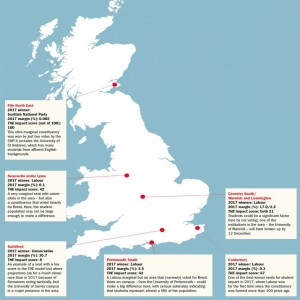
Student populations can make a big difference to a constituency’s make-up, and with the 12 December election taking place during term-time, we may see the student vote having an impact on certain seats.
THE’s data editor, Simon Baker, has crunched the numbers and come up with a student impact score for each constituency. In this General Election 2019 special podcast, he explains how this works and discusses which seats might lead to some surprising results.
Read more:
UK general election 2019: where could students impact the vote?
Students risk missing out on votes as universities lag on registration

Thursday Dec 05, 2019
Thursday Dec 05, 2019
Two experts in AI discuss the big ethical questions about the technology that are keeping them up at night. Plus, they consider how universities can be a driving force for ethical AI development and what, if anything, can be done to develop global AI regulations.
At the THE Live in November, Sara Custer, digital editor at Times Higher Education, sat down with Kate Devlin, senior lecturer in social and cultural artificial intelligence at King's College London and Nathan Lea, a senior research associate in clinical epidemiology at the Institute of Health Informatics at UCL. This is a recording of that panel.
Friday Nov 29, 2019
Friday Nov 29, 2019
The General Election is fast approaching and the party manifestos are finally out. Labour is promising to cut tuition fees, the Conservatives want more of a focus on science and the Liberal Democrats would rather not mention HE at all. But what are all of the parties really offering for higher education and how are they proposing to achieve their aims?
THE’s deputy news editor, John Morgan, talks us through the main parties’ manifestos, providing an essential breakdown of what they are pledging and where they are lacking, and analyses what such promises could mean for higher education.
Read more:
https://www.timeshighereducation.com/news/lib-dems-seek-sidestep-fees-trauma-he-review-pledge
Friday Oct 11, 2019
Friday Oct 11, 2019
In the first episode of our series spotlighting university leaders we speak with David Llewellyn, vice-chancellor at Harper Adams University a specialist agriculture institution in the UK.
He tells us about how coming to the role with no agricultural or academic background has influenced his leadership style of spotting talent and giving people space to expand their abilities.
And of course with farming expected to be the sector hit hardest by the UK leaving the EU, we asked about how he is preparing the agricultural community for Brexit.
Friday Sep 20, 2019
Friday Sep 20, 2019
At the recent World Academic Summit at ETH Zurich, Nobel laureate astrophysicist Brian Schmidt interviewed rising star physicist Sabrina Gonzalez Pasterski about her career and the notion of "genius".
In this interview they talk about their successes and failures and what environments need to be created to encourage genius moments more than geniuses.
Find more coverage of the Times Higher Education World Academic Summit here https://www.timeshighereducation.com/policy/world-academic-summit
Monday Sep 02, 2019
Monday Sep 02, 2019
What does it really mean to decolonise the curricula and pedagogy of higher education? Dr. Meera Sabaratnam, senior lecturer in international relations at SOAS University of London and chair of the decolonising SOAS working group joins the podcast to discuss what decolonising looks like in a UK context and how it goes well beyond just the content of a course.
Kaleke Kolawole, a graduate of the African studies master's programme at SOAS University of London and a facilitator for decolonising toolkits also joins to explain why this work should extend to secondary and primary education.
And Myriam Kane, a member of Goldsmiths Anti-Racist Action (GARA) and a former member of the National Union of Students' national executive council, gives a first-hand account of the 137-day student protest at Goldsmiths, University of London and why cultural competency training for all staff and annual funding specifically for black history events were among the protestors' demands.
Thursday Jun 27, 2019
Thursday Jun 27, 2019
In a roundtable discussion hosted in partnership with TMP Worldwide, Times Higher Education editor John Gill sits down with talent recruitment professionals and UK university human resource directors to discuss competing globally to find the right candidates amid Brexit negotiations, Augar review recommendations and pay and pension disputes. Delegates also reflect on the challenges of progressing towards a diverse and equal workforce.
Around the table are Robert Peasnell, managing director at TMP Worldwide; John Quirk, client partner at TMP Worldwide; Richard Billingham, executive director of HR and organisational development at Aston University; Kesar Kalim, director of HR at London School of Hygiene and Tropical Medicine; Rob Butler, assistant director of human resources - employment services and information at Queen Mary University of London; Janis Westly, deputy directer of HR and head of HR operations at City University London; Polly Fryer commercial director for THE Hiring Solutions; and Nick Davis, strategic solutions director for THE Hiring Solutions.
Friday Apr 05, 2019
Friday Apr 05, 2019
Times Higher Education's data editor Simon Baker joined Sara Custer to discuss THE's recent data-led stories: China's ascent to a global research super power, the drop in humanities PhD graduates over decades and the recent deficits reported by a quarter of English universities.
Links to the stories:
https://www.timeshighereducation.com/features/will-china-be-new-centre-gravity-world-research
https://www.timeshighereducation.com/news/anti-humanities-rhetoric-blame-slower-phd-growth
https://www.timeshighereducation.com/news/more-quarter-uk-he-institutions-post-deficits
Monday Mar 04, 2019
Monday Mar 04, 2019
Data scientists at Times Higher Education are busy analysing thousands of data points evidencing how universities are contributing to the United Nation’s Sustainable Development Goals.
The result will be THE’s Inaugural University Impact Rankings that will launch on 3 April at the Innovation and Impact Summit at the Korean Advanced Institute of Science and Technology.
Duncan Ross, THE’s chief data officer, Phil Bay, THE’s chief knowledge officer and Tim Sowula, head of content and engagement for the World Summit Series join Sara Custer to talk about the methodology behind the rankings and the ambition that inspired this project.
Tuesday Feb 26, 2019
Tuesday Feb 26, 2019
Before digital literacy can become the fourth pillar of education – alongside reading, writing and 'rithmetic – educators must first agree on what being digitally literate actually looks like and where the gaps in understanding lie. And what about digital media platforms themselves – should they be involved in this instruction?
Sara Custer speaks with Jo Coldwell-Neilson, associate dean of teaching and learning at Deakin University, who argues that nobody is actually a digital native, and Joel Breakstone, director of the Stanford History Education Group, who says that the approach to teaching digital literacy needs to be updated, but there are reasons to be optimistic.